Posts Tagged ‘Legal Rights Forum’

Karachi Police Station Visits

Friday, July 3rd, 2009

Legal Rights Forum arranged to visit a few police stations in Karachi today.  Two car-fulls of attorneys and I pull up to the Artillery Maidan Police Station in one of the high security areas in Karachi.  We are greeted in an air-conditioned room that feels like it’s stamping the cigarette-smoke smell into your clothes.  An officer seems happy to answer our questions.  LRF is concerned about the techniques of the investigation officers as well as the force’s awareness of the 2000 Juvenile Justice System Ordinance (JJSO) which provides that juveniles should be treated differently than adults.  Juveniles are not supposed to be hand-cuffed (unless the crime is heinous), they are not to be kept behind bars, and the ordinance provides strict rules about getting in contact with parents. 

Of the few officers in the room, none of them have received any special instruction as to the JJSO.  Only one knew it existed, and he took us to a dusty framed poster on the wall of the interior of the station that had some juvenile rights outlined.  It was made and provided by an NGO called “Advocate,” but it was outdated and not payed attention to. 

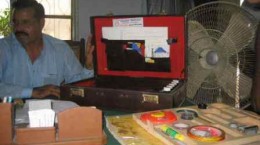
We then went into another room where another officer brought us the “tool kit” of the investigation officers.  He said proudly, “The officers have this kit with each time they make a single investigation.” 

 toolkit1_030709.jpg

I looked for jars of glitter because I thought I’d seen this kit before in my kindergarten class on craft day.  I can’t imagine these glue sticks, plastic gloves and scotch-tape fingerprint set are the most reliable of methods on which a person’s freedom should rely.  The officer continues, “We do not use unfair methods to get confessions, only psychological methods…”  What does that mean?  Psychological methods?  I ask: is there a science to these psychological methods?  He says (as I understand through what was translated back to me), “Of course, medical students are trained in this.”  Javed, a friend of LRF who is with us on the visit says to me, “Sounds like not,” with an unfortunate smile.

toolkit2_030709.jpg

At the next police station, the Boat Basin and Clifton area station, we are greeted in another stale but cool room.  The officers here have the same lack of awareness as to the juvenile ordinance and nonchalant attitude about answering our questions.  They seem to understand that their responses are inadaquate, but don’t seem to feel responsible.  Here, as the officers realize the practices are not up to code, they admit suboptimal performance and cite lack of budget.  They simply don’t have the budget to get continuous training, they don’t have any information in their syllabus on the juvenile code, and they all admit their salaries are insufficient.  Javed looks at me during the salary discussion as a cue because I’d been asking the previous week about officers accepting bribes. 

Another try at questioning the psychological tricks method: what are the psychological tricks?  An officer responds, “We look to see if the accused is jittery or anxious, sweating…”  Javed says, “Did you have any training in this?”  The guy directly says, “No, none at all.”  I was surprised that he seemed to know that that question ended it.  He didn’t even try to pretend he had some superior intellectual ability to judge guilt.

Safi of LRF hands over the framed posters citing several key sections of the Juvenile Justice System Ordinance, which the stations agree to post.  LRF, in its visits to each police station, also requests for the officers to fill out a simple questionnaire on the juvenile rights.  Tahir is compiling summaries of these questionnaires to draw attention to the lack of awareness in the police stations.

[Slashdot] [Digg] [Reddit] [del.icio.us] [Facebook] [Technorati] [Google] [StumbleUpon]

Karachi Youthful Offender Remand Home Visit

Monday, June 29th, 2009

Today we have a visit to the remand home, where Legal Rights Forum wants to establish a Juvenile Rehabilitation (Career Training) Center.  In the cab we go, and we drive about 20 minutes outside of Karachi’s center to the home.

 remand-home.jpgRemand Home Entrance

When we get to the home, Safi - an LRF advocate - stops at the fruit cart outside and buys several bushels of bananas for the youthful accused living there.  Living in the home currently are 15 young boys.  The number fluctuates, depending on the pending cases.  Juveniles between the ages of 12 and 16 are referred to the home by judges.  Youth who cannot post bail or those who cannot meet surety fees and thus are not released are among the residents.  The head of the home is quite friendly and greets us with respect.  He is happy to accept the poster Tahir brings for display in the home – the poster states in simple terms the rights that juveniles have according to law along with contact information for LRF in case they feel they’ve been mistreated. 

The head of the remand home leads the way to visit the inside and talk to the kids.  As we walk toward where they are, several guards jump to our defense.  I’m not a gun expert, but at least two dudes cock what look like automatic rifles.  From that display, I’m expecting crazy-eyed wild children or something, but just as I looked ahead, there were a couple rows of young nervous-looking kids.  As soon as they saw us, they quickly stood, nodded their heads and said in unison, “Asalam-e-lekom” for a peaceful greeting.  I felt awkward that these kids were obligated to jump to attention like that just because of our presence.  We told them to please be comfortable and seated, which they cautiously did with a glance the head guy. 

“Would you like to speak with them?” Safi asked me.  I’m thinking: um, not really; I felt so strange about demanding anything from these kids.  I guess in a way I’m naïve to think they looked so innocent and nervous.  About half of them have these astonishingly bright blue-green eyes that make such a notable contrast with their somewhat dark skin tones and hair.  Safi picks one of the older-looking ones and asks him to come to the front and talk to us a bit.  Safi’s tone is serious and the kid is a bit shaky.  He loosened up a bit as Safi just asked some basic questions.  He’d been arrested with 3 sticks of opium.  Saima translated for me as Safi asked the kid whether he had been mistreated by the police.  He said no.  Another younger looking kid was sitting toward the front with a look of mischief.  He was 12.  I was curious to hear his charge.  When I heard, I was shocked: attempted murder?!  Turns out his case had been reported in newspapers: he found a 5 or 6-year old neighbor child had been strangled and went to tell the child’s parents.  The parents then accused him of the strangling.  This kid had been staying in the home for two months as he waited for court proceedings.  This is the only remand home in the country, and he has to travel hours to get to court.  LRF dreams more homes can be established throughout the country.  It’s on the list of goals. 

For now, LRF looks forward to developing its Juvenile Rehabilitation Program in the remand home: 3- or 6-month courses on electronics’ hardware training for the children.  The courses also have lectures on ethics and morality.  Tahir, of LRF, has spoken to some business centers around Karachi, 3 of which have agreed to provide work to skilled hands that emerge from the program.

[Slashdot] [Digg] [Reddit] [del.icio.us] [Facebook] [Technorati] [Google] [StumbleUpon]

Intern’s Introduction to Karachi City Court

Monday, June 29th, 2009

Tahir, the Legal Rights Forum Chairman and 2008 JusticeMakers Fellow, and his roommate pick me up at 10:30am to head to Karachi City Court.   On the way, Tahir tells me of the people I will meet at the courthouse today and points out legal buildings and landmarks on the way.  We drive into parking for advocates (lawyers), say goodbye to Tahir’s roommate who is also a lawyer and wander through the court grounds.  The courthouse has five main buildings, one for each district: North, South, East, West and Central.  We head to the East district building to a meeting room.  On the way, I see a range of people: from prisoners in 6-person handchains, to parent-child sets, from poor beggars to rich officials, including of course lawyers, judges and police.  I can see hints of the hierarchy among the lawyers and other government officials, but I have yet to sort it out.

Malik Tahir Iqbal, IBJ’s 2008 JusticeMakers Fellow and Chairman of Legal Rights Forum.

During the five-minute walk to the meeting place, I was mentally drained as I accepted being a magnet for eyes.  From out of nowhere, a beautiful necklace of fresh flowers was draped over me.  I turned to be introduced to the modest confidence of Saima, an LRF advocate who I’d been in touch with over email.  Before I could finish that introduction, another flowery string came from the opposite direction.  In seconds, I’d been introduced to tens of people whose names I struggled to retain, and my hair smelled very fresh.  I followed introductions through a set of smiles and chatter into a room where tea and cookies were brought.  I was asked to give a small speech with introduction of myself.

Greeting Intern’s greeting in City Court

At the courthouse, after tea and introductions, I went on a tour of the East building, guided by Saima and Safi, two LRF members. Safi, an LRF advocate, walks me over to a set of chained accused to show me the handchains.  The chains grind around the wrists where they leave clear welts on the skin.  LRF would like to petition the legislature to make 6-person chains illegal, but there are more primary problems.  If the police are not following the laws, the petition to change the law seems secondary.  Tahir says the type of cuff used on the prisoners, a chain-link cuff, is already illegal but the police use them anyway.  Tahir said the police who retain the accused claimed they did not have the other type of handcuffs; advocates requested the legal cuffs from a government office which were apparently sent but are still not used.  Another man I’m brought to see suffered a beating on the day of his arrest.  He claims the police beat him, and the police say it was other people.  The police did not fill out the required medical form, so the truth is uncertain.  LRF is concerned for cases like this.  These accused citizens have the right to be treated properly as well as for legal representation.  

Illegal ChainsIllegal Chain Links Grouped AccusedPrisoners Chained in Groups 

[Slashdot] [Digg] [Reddit] [del.icio.us] [Facebook] [Technorati] [Google] [StumbleUpon]

Legal Rights Forum begins poster campaign in Pakistan

Thursday, April 30th, 2009

To increase membership in the JusticeMakers online community, Tahir and the Legal Rights Forum (LRF) have started advertising by distributing JusticeMakers cards at the Karachi Bar Association and other district bar associations. They have reported a positive response from young and more senior lawyers alike, and are excited at the prospect of having dedicated and determined individuals contributing their professional skills to our cause.

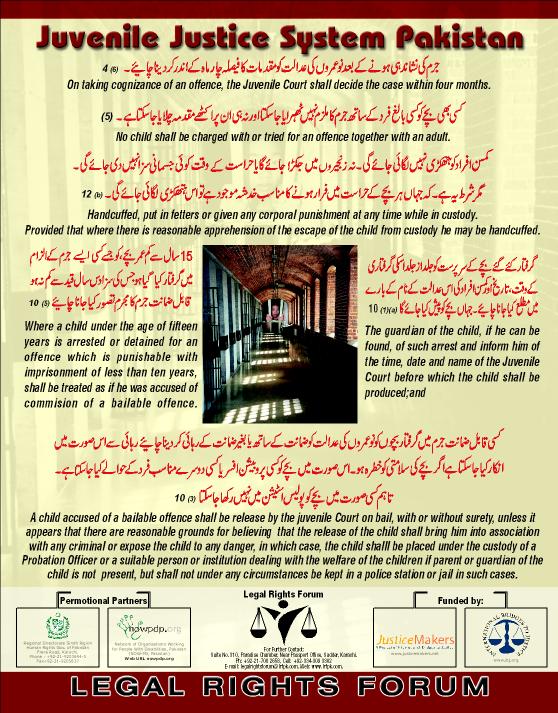
In addition, the LRF have prepared posters to inform the public on juveniles’ rights, specifically the mechanism of accountability under the Juvenile Justice System Ordinance 2000 which is intended to end torture of juveniles in prisons. Conscious of the credibility that ties with international organizations lend, the LRF have put an International Bridges to Justice (IBJ) and JusticeMakers logo on the poster. The posters are being displayed at police stations, and target not only police officers but also visitors and detainees.

lrf_poster_300409.jpg

[Slashdot] [Digg] [Reddit] [del.icio.us] [Facebook] [Technorati] [Google] [StumbleUpon]

JusticeMakers team fights case involving police abuse and extortion in Pakistan

Tuesday, March 31st, 2009

Legal Rights Forum’s latest case involves police corruption and violation of legal rights. An eye witness recorded the license-plate number of a getaway car. The witness says that of the five accused, three fled on foot while the other two escaped in the car. However upon receiving a bribe from the accused, the police effectively erased the license-plate number and any mention of the car from police records. They then recorded a new license plate number for the getaway car - that of a rental car - and identified seven new suspects. The police submitted this misinformation in their final report. To make matters worse, the police have been accused of serious violations of the rights of the accused; in addition to physically abusing the suspects, the police did not ensure that the identification process was carried out by a magistrate, as required by law, but instead illegally went through the process in the police station.

The LRF filed a bail application, in addition to arguing for the release of the suspects based on Section 265-K of the Criminal Procedure Code, which states that the accused can be acquitted at any stage, “Where the charge is groundless and there is no possibility of conviction of the accused.” The verdict of the case is still to be determined.

[Slashdot] [Digg] [Reddit] [del.icio.us] [Facebook] [Technorati] [Google] [StumbleUpon]