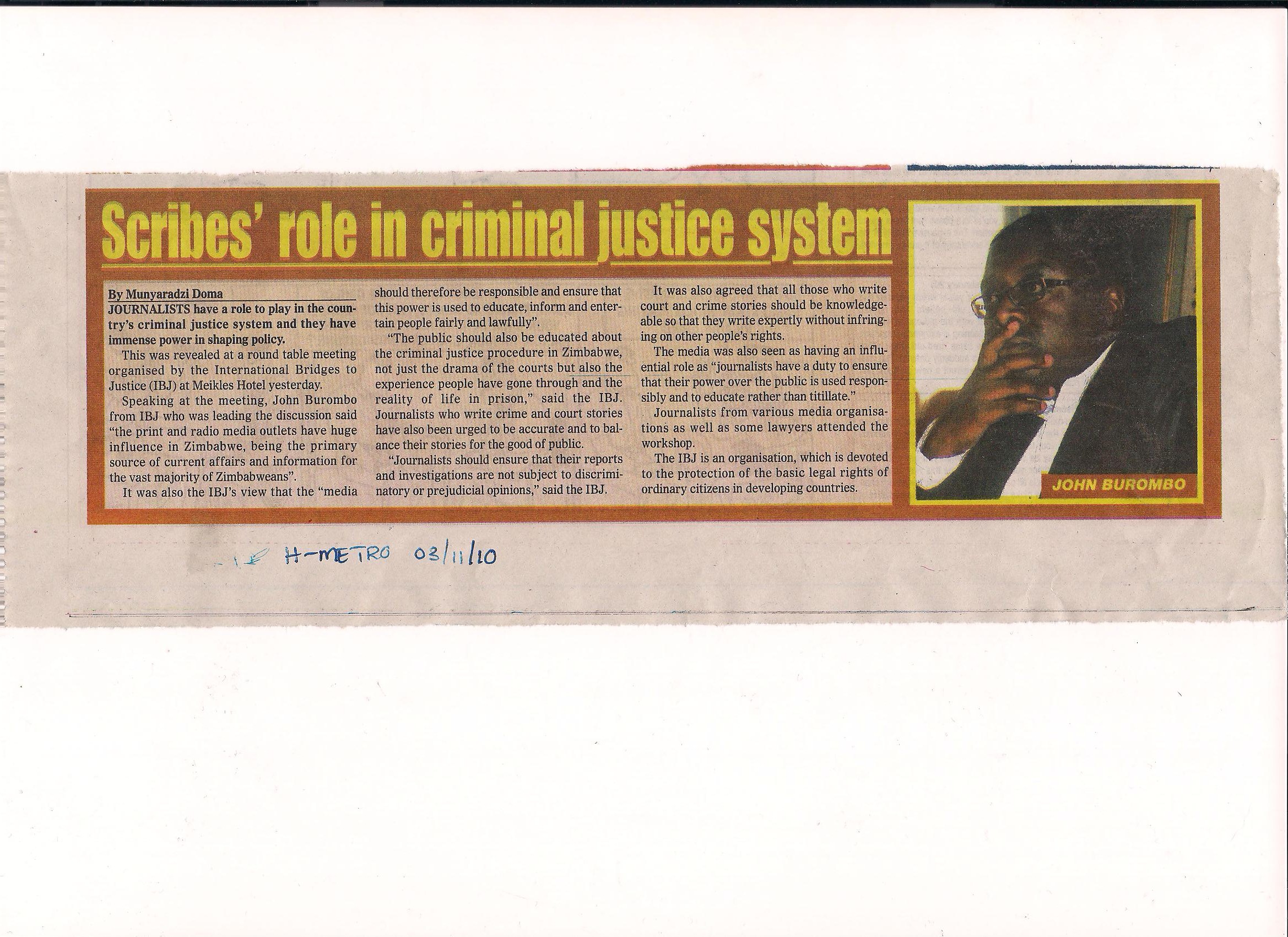
Posts Tagged ‘John Burombo’

Zimbabwe: a series of legal defense trainings and awareness-raising activities to be conducted in May

Tuesday, April 13th, 2010

The month of May will be rich of colorful events in Zimbabwe. From May 14th-16th, a legal defense training will be conducted in Harare, with the aim to build on last year’s training conference by training the core group of IBJ volunteer lawyers at a more advanced level. All 40 members of the team of volunteer lawyers - who, along with IBJ fellows ‘efforts, have defended more than 130 detainees last year - will gather to discuss ways to leverage the existing legal framework to ensure systematic protection of the rights of the accused, in particular early access to counsel, freedom from torture and speedy trial. Lawyers from the Legal Aid Directorate, the State-sponsored legal aid organ, will engage with private lawyers on ways to strengthen the existing legal aid system and to expand access to justice to provinces, where legal needs remain widely unmet. The training will be led by Anthony Natale, a practicing trial lawyer for 30 years. Presently, he is a Supervising Assistant Federal Public Defender in Miami, Florida and the training coordinator for the Federal Defender Office for the Southern District of Florida. His experience as a criminal defense trainer in China, Vietnam and Zimbabwe will offer a comparative approach and inspire Zimbabwean lawyers to identify within their own laws provisions that can be leveraged to ensure speedy justice.

3235675737_4df36f8280.jpg

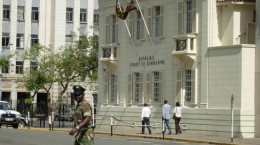
Above: The Supreme Court of Zimbabwe in Harare (Photo by Florence Chatira)

The training will promote an interactive approach where lawyers will be put in the situation to develop the theory of the case, interview a client and cross-examine witnesses. IBJ International Program Director, Sanjeewa Liyanage, and IBJ Zimbabwe Fellows, Innocent Maja and John Burombo will appeal to lawyers’ inner values and urge them to take action to improve the fair and speedy delivery of justice across the country. At the end of the training, lawyers will be offered the possibility to take pro-bono cases to stem the tide of the country’s legal needs. The last day of the training will be devoted to identifying and training senior lawyers become instructors/trainers themselves. The hope is to empower local lawyers with a set of teaching skills so that they can themselves later replicate legal defense trainings and mentor their peers throughout the country. Next regional training session in the Fall 2010 will integrate these local instructors in order to increase the sustainability of the training approach.

mission_statement.jpg

Above: The Mission Statement of the Zimbabwe Ministry of Justice, Legal and Parliamentary Affairs.

To ensure that Zimbabwean lawyers are able to learn “on the job”, follow-up one-on-one mentoring sessions will be conducted at IBJ’s Defender Resource Center in Harare on May 17th and 18th. Anthony Natale will spend time with lawyers to dissect the nuances of their case and help them more fully utilize the portfolio of lessons drawn from the training and the criminal defense handbook. The goal is to provide individualized and innovative solutions to challenges that arise from specific cases and help the accused get the most professional defense possible - especially in cases featuring homicide or other serious crime that could result in the death penalty.

As access to legal aid crucially lacks in provinces, the goal of the series of trainings is also to increase the total number of lawyers trained by reaching out to new areas where IBJ was not present before. Following activities in Harare, the IBJ team will head to Bulawayo to conduct a legal defense training on May 22nd and 23rd. Zimbabwe’s second biggest city, Bulawayo has a rich legal tradition which IBJ hopes to build upon to promote access to justice in Matabeleland North Province. The training will focus on increasing the capability of provincial lawyers to provide competent defenses to accused persons, particularly indigents, of which has been a problematic issue for many Zimbabweans. The training will explore a plethora of legal concepts such as cross-examination and procedures to prevent torture against prisoners, helping the participating lawyers in garnering invaluable skills and building a provincial movement in favor of the protection of the rights of the accused.

3236522510_97d6528ed7.jpg

Above: Zimbabwean street vendors (Photo by Florence Chatira)

This series of trainings will be an opportunity to intensify awareness-raising and community-building activities by engaging with local partners, meeting lawyers, observing trials and visiting prisons.

[Slashdot] [Digg] [Reddit] [del.icio.us] [Facebook] [Technorati] [Google] [StumbleUpon]

IBJ Fellows Innocent Maja and John Burombo speak on the fundamental rights of the accused in Zimbabwe

Wednesday, April 7th, 2010

IBJ-Zimbabwe Fellows, Innocent Maja and John Burombo, recently held an interview with Zimbabwe Broadcasting Corporation’s SFM on the importance of the implementation of IBJ’s rights awareness campaign in Zimbabwe. The 30-minute interview, with SFM’s Tashinga Masawi, was held on 19th March and aired on SFM’s programme Morning Mirror on 22nd March. This interview was a follow-up to the roundtable discussion held by IBJ on 18th March to strategize on the implementation of the rights awareness campaign.

During the engaging interview, the Fellows commenced by outlining IBJ’s mandate and objectives. They outlined and explained IBJ’s approach, using the three-pillar programming consisting of defender capacity building, criminal justice reform and human rights awareness. The Fellows then outlined the rights available under the Constitution of Zimbabwe to protect people who are believed to have committed criminal offences. These include, among others, the protection against arbitrary arrest; being promptly informed of the reason for an arrest; being allowed to engage a lawyer without delay; being brought before court without undue delay; the entitlement to bail; and the entitlement to a fair trial without delay.

After outlining these rights, the Fellows then outlined the strategies IBJ was to utilize to implement the rights awareness campaign. These included use of dramas and movies, use of the print and electronic media, use of posters and leaflets, use of manuals, use of t-shirts and other regalia, putting up of billboards and doing road shows.

In conclusion, the Fellows emphasized the need for citizens to be made aware of their Constitutional rights. They stressed the importance of rights awareness in its capacity to empower citizens to enable them to exercise their rights. This would, in turn, help ensure that citizens are able to access justice by asserting these rights.

[Slashdot] [Digg] [Reddit] [del.icio.us] [Facebook] [Technorati] [Google] [StumbleUpon]

Zimbabwe: creation of an e-group to follow-up on the action plan of a roundtable discussion on rights awareness strategies

Wednesday, April 7th, 2010

IBJ-Zimbabwe Fellows, Innocent Maja and John Burombo, recently held a roundtable discussion with its partner organizations, LRF and ZACRO, journalists and private lawyers to strategize on how to implement IBJ’s rights awareness campaign in Zimbabwe. During the engaging and fruitful discussion, held on 18 March in Harare, the participants were able to identify the main areas requiring rights awareness in Zimbabwe. These included issues related to arrest, search and seizure, access to legal counsel, appearance before court timeously, bail, institutional reforms, legal aid, timeous execution of cases and empowerment of citizens to assert their rights.

After identifying these areas, the officers then proposed strategies on how to implement the campaign. They agreed that it was important to identify the particular target groups for the campaign to come up with specific strategies for each group. This would entail using clearly focused mechanisms. These mechanisms included use of dramas and movies, use of the print and electronic media to demystify the rights, use of posters and leaflets, use of target group-specific manuals, use of t-shirts and other regalia, putting up of billboards and carrying out of road shows to reach out to all communities. The participants also believed there was need to engage other state institutions, like the police, and have them participate in the campaign as well. It was agreed that this would go a long way in building a culture of respect for human rights.

The participants then came up with specific action plans for the implementation of these strategies. It was agreed that an e-group for all participants be created to ensure that the commitments agreed upon are followed up and implemented. Participants expressed gratitude at the hosting of the discussion by IBJ, with one participant commenting that the “discussion atmosphere was good and enabling.”

[Slashdot] [Digg] [Reddit] [del.icio.us] [Facebook] [Technorati] [Google] [StumbleUpon]

IBJ lawyers’ perseverance help reunite a Zimbabwean family

Monday, January 18th, 2010

His name is Prince Mavaro. At the time of arrest, he was 23 year-old and married with a child aged 1. As his wife was unemployed, he was the sole breadwinner of the family. In May 2008, he was arrested on charges of unlawful entry. Prince could not afford to engage a lawyer to defend his legal rights. He stayed in remand prison for 10 months before IBJ fellow John Burombo started assisting him.During interrogations, he was severely assaulted by the police: he was tied up and beaten under the feet and on the knees with baton sticks and bottles. For several weeks, he sustained a series of injuries, including swollen feet, which made it very difficult for him to stand and walk. He spent almost three weeks in police custody before he was taken to a court of law. He pleaded not guilty to the charge and complained to the court of the ill-treatment he had suffered at the hands of the police but no action was taken. He was remanded in custody.

At that time, the remand prison was going through a serious crisis, including overcrowding, food shortages, and lack of access to medical treatment. Inmates barely had a single decent meal per day and diseases like pellagra and cholera were rampant. The last truck which transported the prisoners to and from courts broke down in May 2008, leaving them enable to attend trial. Prisoners were therefore continually remanded in custody in absentia.

When John commenced legal assistance the main concern was to get Prince out of custody. He applied for bail but it was denied. With the court system seriously dysfunctional, the State was taking a considerable time to bring the matter to trial and Prince continued to be remanded in custody, leaving his wife and baby totally vulnerable. John therefore decided to apply for a refusal of the further remand of Prince pending trial. In March 2009, such application was made to the court. After considering all submissions, the court upheld the application. Prince was discharged and released from custody. He almost spent one year in remand prison. He could barely hide his happiness and gratefulness at recovering freedom after such a long time away from his wife and 1-year old baby.

[Slashdot] [Digg] [Reddit] [del.icio.us] [Facebook] [Technorati] [Google] [StumbleUpon]

21-year-old Zimbabwean reunited with his grandmother and young brother

Wednesday, December 16th, 2009

Mukarati Farayi is 21-years old. He got arrested in February 2009 on two counts of unlawful entry and theft. He was not able to engage the services of a lawyer. By the time IBJ Zimbabwe Legal Fellow John Burombo started assisting him, he had spent 8 months in remand in the most adverse and inhumane conditions.Orphaned of his two parents, he grew up with his maternal grandmother and his 6-years-old brother who is deaf and mute. Before his arrest, he was the family’s sole breadwinner, doing low-paid part-time jobs here and there. His grandmother could not afford to visit him in remand prison.

When he first met John, he expressed his concern at the welfare of his family in his absence, particularly his brother who is at school. John promised him to do all he could to assist him. John immediately filed an application for bail. Mukarati was granted bail of US$50. Unfortunately, neither him nor his family could afford to pay such an amount of money.

But John did not get discouraged for all that. He tried to have the bail reduced and pushed for the trial to commence. However, because of the court system congestion, nothing happened. John then filed an application for refusal of further remand since the State took a long time to commence the proceedings. The court upheld the application. Mukarati was released and re-united with his grandmother and young brother after 8 months spent in remand prison. He could barely hide his delight.

p1010743_john_resized.JPG

Above: IBJ Legal Fellow strives to provide committed counsel to vulnerable prisoners in Zimbabwe. (Photo by Florence Chatira)

[Slashdot] [Digg] [Reddit] [del.icio.us] [Facebook] [Technorati] [Google] [StumbleUpon]

Zimbabwe Magistrates suggest solutions to reduce pre-trial detention

Monday, August 10th, 2009

On 31 July 2009, IBJ-Zimbabwe Fellows, Innocent Maja and John Burombo, collaborated with the Legal Resources Foundation (LRF) to bring 16 magistrates together to discuss the role magistrates can play in decongesting Zimbabwe’s prisons. In a frank and engaging conversation, Magistrates indicated that their challenges include political interference, lack of resources leading to demotivation, corruption, and judicial procedures (e.g invocation of section 121 of the Criminal Procedure and Evidence Act) that limit their ability to make proper decisions. So open was the discussion that one participant admitted, I “didn’t expect the level of openness that was received.”

rdtable-number2-zim-01.png

Above: from left to right: former Magistrate and Head of the Legal Unit of the Legal Resources Foundation, Evangelista Kabasa; IBJ Zimbabwe Fellow and Country Manager, Innocent Maja making a strong case for bail releases of detainees accused of minor offenses to decongest the country’s prisons. (Photo by Florence Chatira).

After discussing the problems and sharing experiences, the magistrates came up with practical solutions to these problems. The Magistrates committed to do the following:
(i) Grant bail to every accused person that appears before them as of right unless the state
proves otherwise;
(ii) Stipulate a quantum of bail that matches the offence and the offender;
(iii) Patiently secure the rights of the unrepresented accused persons;
(iv) Consider community service and fines first and then imprisonment last in sentencing;
(v) Train and mentor junior Magistrates in sentencing, the first such training being held on
14 August 2009;
(vi) Lobby for the repeal of section 121 of the Criminal Procedure and Evidence Act).
Magistrates undertook to compile all cases where section 121 was invoked, ascertain how many were eventually pursued and then make a case.
(vii) Undertake monthly prison visits;
(viii) Co-operate with IBJ to produce Sentencing Guidelines and Court Management Manual.

rdtable-number2-zim-06.png

Above: The roundtable participants reflecting upon the challenges plaguing the Zimbabwean prison system and solutions to alleviate  pre-trial detention and prison overcrowding. (Photo by Florence Chatira)

Throughout the event, the Magistrates were motivated and dedicated to working with IBJ and other players in the criminal justice system to improve prison conditions and reform the criminal justice system. The event was a resounding success. IBJ will continue to provide the necessary platform for this to be achieved.

rdtable-number2-zim-08.png

Above: Provincial Magistrate Mishrod Guvamombe leading the discussion on proposed solutions. (Photo by Florence Chatira)

[Slashdot] [Digg] [Reddit] [del.icio.us] [Facebook] [Technorati] [Google] [StumbleUpon]

Committed to Reform: First Roundtable Discussion on Decongesting Zimbabwe’s Prisons a Success

Thursday, July 16th, 2009

On July 7, 2009, participants of IBJ-Zimbabwe’s first official roundtable discussion spoke passionately about the role of lawyers in decongesting Zimbabwe’s prisons. The discussion was chaired by IBJ Fellow, Innocent Maja. In attendance was Sanjeewa Liyanage, the IBJ Program Director, Professor Geoff Feltoe, five private practicing lawyers and representatives from the Law Society of Zimbabwe, Legal Resources Foundation, and Zimbabwe Association for Crime Prevention and Rehabilitation of the Offender (ZACRO).

roundtable1_150709.jpg

Above: IBJ Fellow Innocent Maja leading a discussion. (Photo by Florence Chatira.)

Participants cited corruption, economic hardship, little resources, and shortage of transport to convey accused persons to court as causes of overcrowding. After much deliberation and IBJ Zimbabwe Fellow, John Burombo presented the concept paper and a moving story of how IBJ Zimbabwean fellows released 26 accused persons from remand prison, participants agreed that lawyers had an ethical obligation to represent indigent accused persons pro bono as one of the means to decongest prisons.

roundtable4_150709.jpg

Above: John Burombo, an IBJ Laywer, presenting during the roundtable discussion.  (Photo by Florence Chatira.)

At the conclusion of the discussion, ZACRO (with the assistance of the Law Society of Zimbabwe and IBJ) undertook to create a database for indigent accused persons in remand prison in need of pro bono legal assistance. Legal practitioners present pledged to take up at least two cases a month pro bono and at a nominal fee, to help indigent incarcerated citizens.

roundtable3_150709.jpg

Above: IBJ Program Director Sanjeewa Liyanage discussing criminal justice with a roundtable participant. (Photo by Florence Chatira.) 

The roundtable was a resounding success. In giving feedback about the roundtable, one participant stated that she had “learnt a lot of things” and another branded the event as “quite insightful and thought provoking.” As IBJ Zimbabwe Fellows look to organize their next roundtable, they are certain it will be another great success.

roundtable2_150709.jpg

Above: Participants in the July 7 Roundtable dicussion in Harare.  (Photo by Florence Chatira.)

[Slashdot] [Digg] [Reddit] [del.icio.us] [Facebook] [Technorati] [Google] [StumbleUpon]