Posts Tagged ‘Africa’

JusticeMaker Buhle Dube’s Views on Human Rights, Africa, and Being a Pilot.

Wednesday, July 1st, 2009

During a free hour in a hectic weekend of workshops Buhle Dube, JusticeMakers grant-winner and law professor at the University of Swaziland, leaned forward and described how he decided to become a lawyer.”Well I think I was always going to be a pilot. Until when I finished high school and I said, ‘I’m going to be a lawyer.’ And the family said ‘No way.’

“That was my cue to say look this is the thing to do. When everybody says, ‘Don’t,’ just go,” he said.

buhle_dube_010709.jpg

Above: 2008 JusticeMaker Fellow Buhle Dube. (Photo by Nicholas Loomis)

This philosophy has served him well while struggling to promote human rights in an African context.

Speaking from a guesthouse in Nhlagano, ahead of meeting with community police in Ngelane, Dube mused on the difficulties of this task.

“Its an African thing really to dismiss human rights as a western concept.

“The term human rights has been labeled un-African in most African societies. We have managed to train all these people without even using the word human rights,” he said.

Using practical terms instead of theoretical concepts Dube has managed to get his message across.

“When you talk about bail you can talk about bail without touching on human rights. Presumption of innocence you don’t have to touch human rights. Prohibition of torture you don’t have to touch human rights,” he said.

Dube believes however that the concept behind human rights is uniquely African.

“My take on that is always, look human rights are very African except we never call them human rights,” he said.

The concept of ubuntu, or humanity, is at the core of these beliefs.

buhle_dube2_010709.jpg

(Photo by Nicholas Loomis) 

“Africa has always held onto values of humanity such as the spirit of ubuntu which says I am because you are and because you are therefore I am.

“If I violate you I violate myself. That’s an African concept ubuntu… It is not termed in human rights but it is the greatest human right ever,” he said.

Not content to philosophize Dube has sought to apply his ideas practically.

“I believe that any legal solution that does not go beyond the walls of the library or that does not go beyond the cover of the journal you are writing in is useless. Take all these theories to the people apply them practically,” he said.

The JusticeMakers team has done just that, by holding workshops with community police, and Dube believes it is making a difference.

“The community police are appreciative of what we have done… In most cases the stuff that we deliver to them they’ve never heard of it before so it really does impact them,” he said.

Perhaps for the first time since choosing to be an attorney Dube is beginning to hear ‘Do’ as well as ‘Don’t’.

[Slashdot] [Digg] [Reddit] [del.icio.us] [Facebook] [Technorati] [Google] [StumbleUpon]

Awakening in Burundi, Part V

Monday, February 23rd, 2009

That night we met with our partner Pierre. He was nervous about the training. He had seen our training plan and didn’t think it would work. He told us that Burundians are shy, reserved people who would be uncomfortable sharing their values and participating in the other training exercises we had designed. I was also feeling nervous and Mehdi confided that he had felt like taking the next flight back to France.

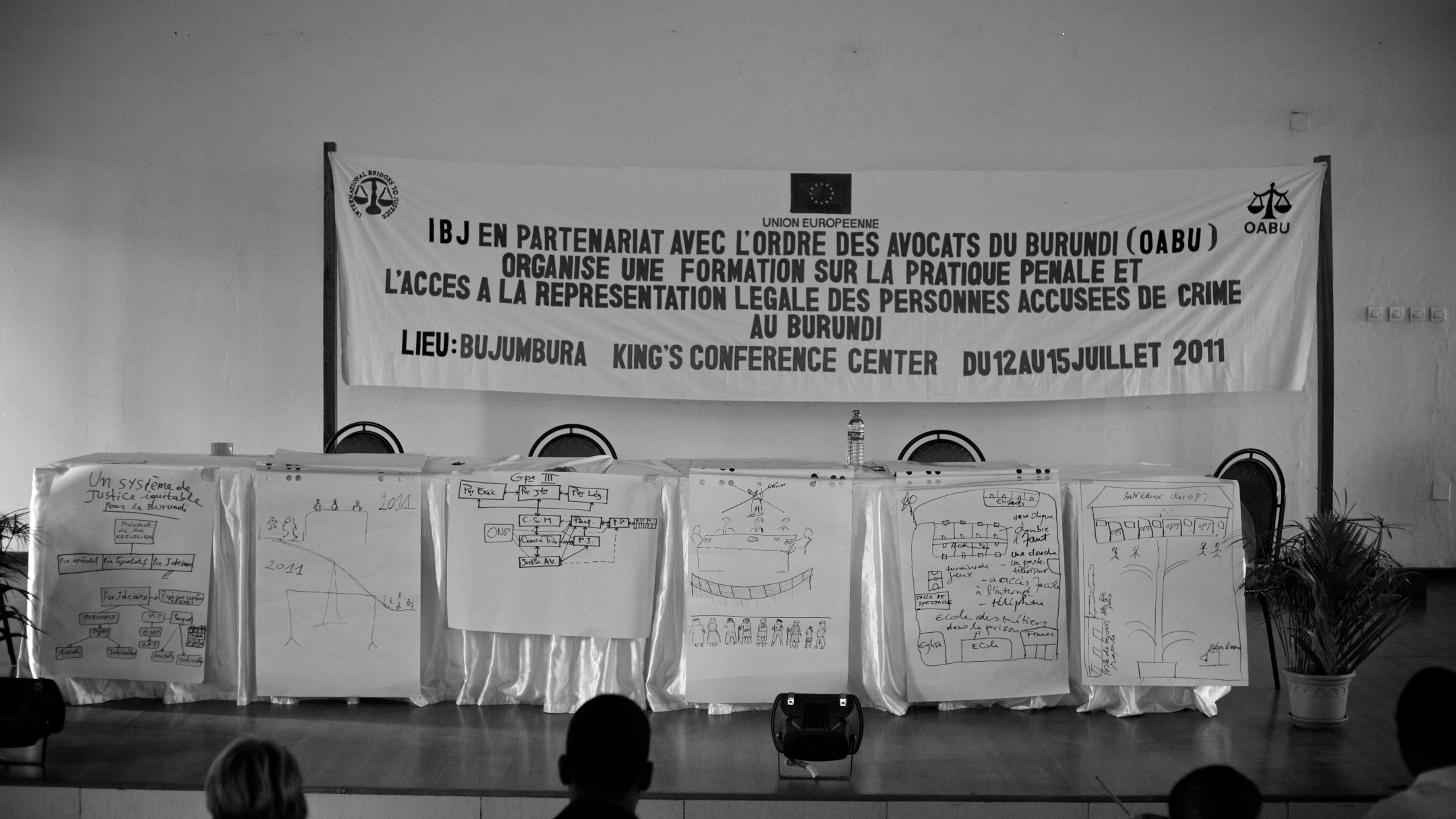
We all woke up very early the next day, ready to begin. I was feeling like I always did on the morning of a trial: anxious, stressed and vaguely unwell. I wondered if people would show up. What kind of solutions could we offer people who have suffered the kind of social upheaval that Burundi experienced? Would the training address the major needs to overhaul a system in need of much attention and fixing?
(more…)

Awakening in Burundi, Part IV

Monday, February 23rd, 2009
The training was to begin on Tuesday, May 20th and we went to court on Monday to get a glimpse of the legal system to prepare for the session. The courthouse had seen better days. Many of the windows were broken and litter was strewn about. Inside the building people were milling about in the halls lethargically. Only one courtroom was conducting business that morning.Inside the courtroom three judges sat on their dais. Unlike the common law system, in civil systems there are no juries, just a panel of judges who function as fact finders and arbiters.

There weren’t any court reporters, computers or clerks to update the files. The court dockets were stacked in a large pile on the bench. I could tell right away that getting justice in Burundi would be a painstaking, inefficient and labor-intensive process.

The courtroom, which would only be handling civil matters that day, was filled to capacity with citizens who would be appearing before the judges that day. In an American courthouse, you would see lawyers everywhere. In fact, there would be more lawyers than clients waiting in the halls. This was not the case in Burundi. Only two attorneys were present that day, excluding Mehdi and me. We later learned that there are only about 90 lawyers for the entire country. Of these lawyers, only a tiny percentage practice criminal law and all of them are concentrated in the capital of Bujumbura.

(more…)

Awakening in Burundi and Rwanda, Part III

Tuesday, December 16th, 2008

After Marlon vigorously searched through IBJ’s resumes, we found a French criminal defender who was interested in IBJ’s work. We called him and within a week we were meeting our trainer. Mehdi Benbouzid, a French criminal defender with extensive experience training lawyers, students and police, has an invested interest in Africa and a commitment to human rights. He also had the necessary amount of francophone civil law expertise, as he had a Law degree and a Masters in Law from Université Jean Moulin in Lyon. He had been actively practicing as a criminal defender for twelve years, all the while teaching and lecturing on criminal law. He had lectured on war crimes and crimes against human rights. He had recently completed work with the International Red Cross in Syria and Jordan as a field coordinator/team leader, interviewing suspected terrorists held in Jordan and providing human rights assessments in Syria. He was perfect.

(more…)

Awakening in Burundi and Rwanda, Part II

Tuesday, December 16th, 2008

IBJ began planning the Burundi training program in earnest in February of 2008. It was my responsibility to adapt our work in China and Vietnam to this training. I was being assisted by a young Zimbabwean attorney, Marlon Zakeyo. Marlon had worked as an intern for IBJ for two years, during which time he had been building relationships with legal organizations in Africa.

(more…)

Awakening in Burundi and Rwanda, Part I

Tuesday, December 16th, 2008

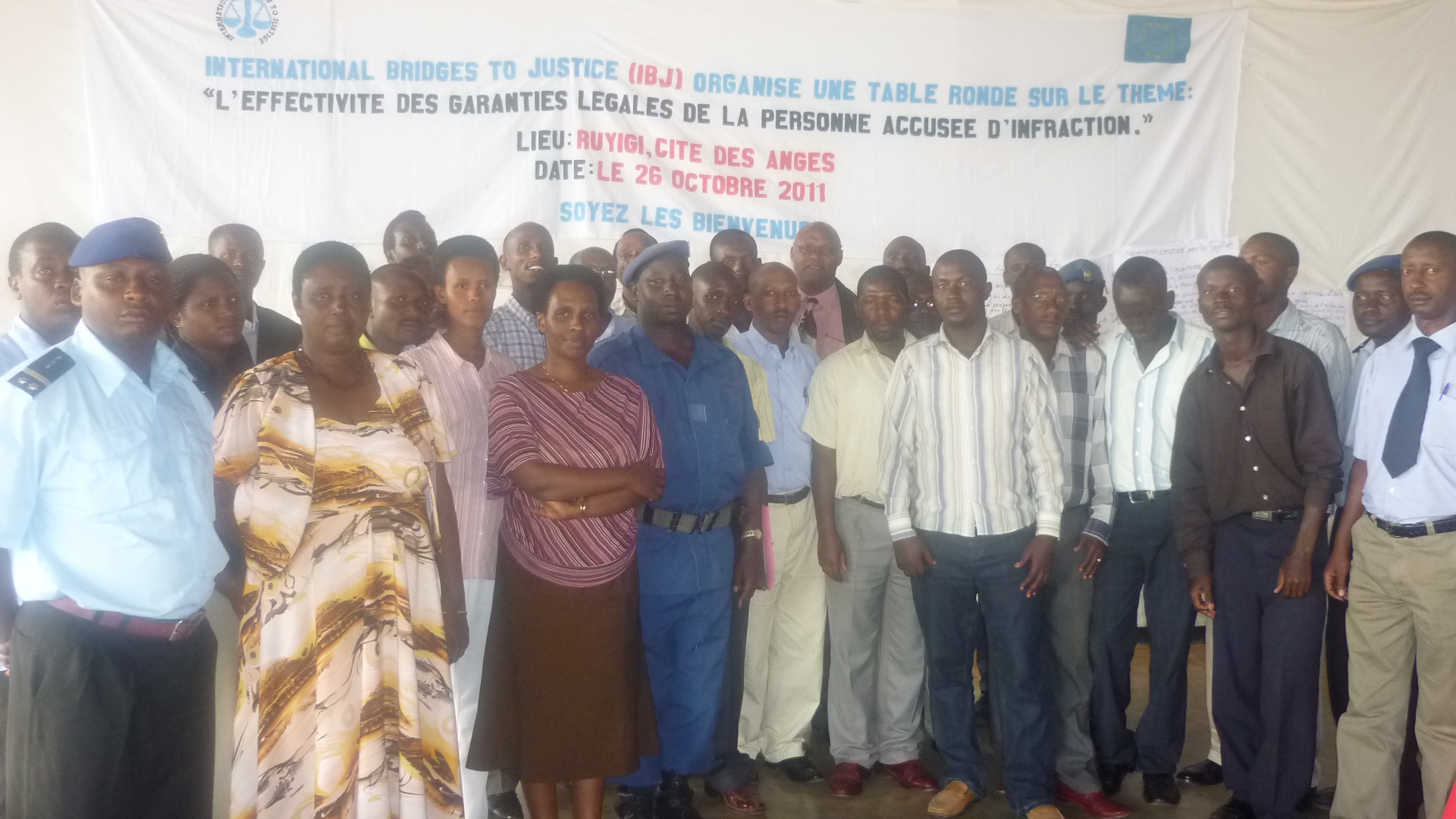
I arrived at International Bridges to Justice in November of 2007 to fill the role of Deputy Director. Prior to working at IBJ, I was a public defender in San Francisco for twenty-two years. I had met the founder of IBJ, Karen Tse, in 1992 when we were colleagues in the SFPD office. After gaining experience as a defender, Karen moved on to a career as an international human rights attorney. She founded IBJ in 2001.When I began working at IBJ, the organization had already developed an expertise in training attorneys and developing systemic solutions to implementing criminal laws in Asia. Preparatory work had already been completed to expand IBJ’s programs into Burundi and Rwanda, and one of my first assignments was to organize the first training of defenders, judges, police, prosecutors and members of civil society in Burundi. Contemporaneously, IBJ had plans to follow up work in Rwanda by launching a rights awareness campaign in that country.

(more…)